What Is Brand Voice (And Why Most Brands Get It Wrong)

Brand voice is not your logo. It's not your color palette. It's not even your tagline.

It's the way your brand sounds when it opens its mouth. Every email, every social post, every caption on every photo. The cumulative effect of all those words, read together, is your brand voice. And most brands either don't have one, or have one they've never thought about.

Both problems are fixable. But first you have to understand what you're actually dealing with.

Voice vs. tone. They're not the same thing.

This is where most brands get tangled up.

Voice is consistent. It's your brand's personality, the through-line that shows up whether you're announcing a new product or responding to a complaint. Tone shifts. It's how you apply that personality to a specific moment. A brand can be warm and direct by nature but still know when to flatten the warmth and just state the facts.

Think of it this way. You have a personality. It doesn't change depending on who's in the room. But your tone does. You talk to your best friend differently than you talk to your boss. That's not inconsistency. That's range.

A strong brand voice has both. A fixed personality and the range to apply it well.

Why so many brands sound like everyone else

Two reasons. And they usually work together.

The first is category default. Every industry has a gravitational pull toward a certain kind of language. Financial services brands default to "trustworthy and approachable." Wellness brands default to "clean and empowering." Tech brands default to "innovative and human-centered." None of it is wrong, exactly. But none of it is distinctive either. When everyone in your category sounds the same, you stop being a brand and start being a commodity.

The second is compliance drift. This one is especially common in regulated industries. Legal review is necessary. But when every piece of copy goes through the same red pen with no voice framework to protect it, what comes out the other side sounds like a disclosure. Technically accurate. Completely forgettable. The fix isn't to fight compliance. It's to build the voice guardrails before anyone picks up that red pen. That's exactly what brand voice development is designed to do.

What brand voice development actually looks like

I worked with Nala's Ranch, a dog boarding and training company out of Spring Hill, on exactly this. They weren't a brand-new business. But they were new enough that they had never stopped to think about how they sounded. They had a personality. They just hadn't named it yet.

We started where I always start: listening. Not to what they wanted to say, but to what their customers were already saying about them. We went deep on their reviews. And something interesting happened. The words their clients were using, warm, trustworthy, like leaving your dog with family, lined up almost exactly with what Nala's Ranch wanted their brand to feel like.

That's the moment it clicked. Not when I showed them a voice guide. When they heard the gap between what they sounded like and what they wanted to sound like, and realized it was smaller than they thought. That kind of momentum is hard to manufacture. But when it's real, it makes every piece of downstream work easier. The campaign concepting, the social media copywriting, the email copywriting. All of it.

The brands that get it right

They treat voice as infrastructure, not decoration.

A strong brand voice framework means your social media manager, your email copywriter, and your front desk team are all working from the same playbook. It means when you bring in outside help, a freelancer, an agency, a contractor, they can get up to speed without a six-week onboarding. It means your brand sounds like itself, consistently, across every channel and every format.

That consistency is what builds recognition. And recognition is what builds trust. And trust is what builds customers who stay.

How to find out if you have a brand voice problem

Read three pieces of your own content out loud. A recent email, a social post, and something from your website. Do they sound like the same brand? Does that brand sound like anyone in particular, or could those words have come from any of your competitors?

If the answer is uncomfortable, that's useful information. It means there's work to do. And the work is worth doing.

Brand voice development is where I spend a lot of my time. If your brand is ready to stop sounding like everyone else in your category, let's talk.

Free download
Got a project? Start here.

Three questions. That's all it takes to brief a copywriter well. Download the template and find out what you actually need to say before you say it.

Download the brief

How to Write a Brand Voice Guide That People Actually Use

Most brands don't have a brand voice guide. The ones that do usually have a PDF that lives in a shared drive nobody opens. Both situations produce the same result: copy that sounds different every time someone new writes it, and a brand that feels vaguely inconsistent without anyone being able to say exactly why.

A good brand voice guide fixes that. But only if it's built right. Here's how to do it.

Start with what you already sound like at your best

The raw material for a real brand voice guide is almost always already out there. Don't start with a blank page. Start with a collection.

Pull the emails your team sends when they're not overthinking it. Find the social post that performed better than anything else this year. Read the customer reviews where people describe you in their own words. Look for the founder's LinkedIn post that got shared far more than usual.

You're looking for patterns. The phrases that keep showing up. The tone that feels most natural. The moments where the writing clicked and nobody had to argue about it. That's your voice, unguarded. That's what you're trying to document.

Adjectives are not a voice

Here's where most brand voice guides go wrong immediately. Someone runs a workshop, fills a whiteboard with personality descriptors, and calls it done. Approachable. Confident. Human. Warm but professional.

Those aren't a voice. They're a starting point at best. Every brand in your category has a list that looks almost identical. Adjectives describe a direction. They don't show anyone how to write a single sentence.

The fix is examples. For every trait you claim, you need to show what it looks like on the page. Not just "we're approachable" but here's an approachable subject line next to one that isn't. Here's how we'd write this product description if we were being true to our voice, and here's how it sounds when we're not. The contrast does more teaching than any descriptor ever could.

The "never" list is often more useful than the "always" list. The words and phrases your brand would never use tell a writer more about your voice than a page of adjectives.

The four things every brand voice guide needs

Voice traits with examples. Three to five characteristics, each illustrated with real before-and-after copy. Not "we're direct" but here's a direct sentence and here's the same thought written passively. Show the difference. (Not sure what your voice traits actually are yet? Start here.)

The never list. Words, phrases and tones that are off-brand. This is non-negotiable. Without guardrails, someone will always drift toward corporate-speak, hollow enthusiasm or whatever they were writing in their last job. Name the things you don't do.

Tone guidance by context. Voice is consistent. Tone shifts. Your brand should sound like itself whether it's writing a product launch or a service outage notice, but those two pieces should not feel identical. Show writers how tone adapts without the voice changing underneath it.

A "sounds like us / doesn't sound like us" section. Real examples, side by side. This is the part people actually use when they're staring at a blank page. Make it specific enough to be genuinely useful.

The test that tells you if it's working

Give the finished guide to someone who has never written for your brand before. Ask them to write three pieces using only the guide as a reference. No briefings, no examples beyond what's in the document.

If the output sounds like your brand, the guide is doing its job. If it doesn't, the guide is missing something. Usually examples. Almost always examples.

A brand voice guide that requires a human interpreter to use is not a guide. It's a philosophy document. Useful for inspiration, useless at 4pm on a Tuesday when someone needs to write a caption.

Brand voice is a practice, not a deliverable

The guide is not the finish line. It's the foundation. The brands that actually maintain a consistent voice are the ones that treat the guide as a living document. They update it when the brand evolves. They add examples when they write something that nails it. They revisit the never list when new bad habits creep in.

One document, maintained well, is worth more than a brand refresh every three years. And it's a lot cheaper.

Build it once. Keep it current. Use it every time someone new sits down to write for your brand. That's the whole system.

If your brand is still working off an adjective list and hoping for the best, let's talk. Building brand voice guides is some of my favorite work, and the difference it makes shows up in every piece of content that comes after it.

Free download
Got a project? Start here.

Three questions. That's all it takes to brief a copywriter well. Download the template and find out what you actually need to say before you say it.

Download the brief

What Is Brand Voice — And Why Most Brands Get It Wrong

Every brand says they have a voice. Very few of them actually do.

What most brands have is a list of adjectives. "We're approachable. Confident. Human." Great. So is every other brand that's ever filled out a positioning workshop template. Adjectives are not a voice. They're a starting point at best. A false sense of security at worst.

Real brand voice is the thing that makes a reader recognize your brand before they see your logo. Consistent enough to be predictable. Distinctive enough to be unmistakable. And a lot harder to build than most brands think.

Voice vs. tone: they're not the same thing

This is where most brands get tangled up. Voice and tone are related, but they're not interchangeable.

Voice is who you are. It stays consistent regardless of context. Tone is how you show up in a given moment. It shifts depending on what you're saying and who you're saying it to. A brand can be warm and direct while still adjusting its tone for a product launch versus a service outage. Same person, different register.

Think of it this way: your voice is your personality. Your tone is your mood. Personality doesn't change. Mood does.

The mistake brands make is treating tone as voice. Rewriting their entire communication style for every channel or campaign, with no consistent thread running through any of it. The result is a brand that sounds like a different company every time you encounter it.

The performing personality problem

There's a specific failure mode I see constantly. And it usually comes from good intentions.

A brand decides it wants to be more relatable. So it adopts a quirky, casual, overly familiar voice. Not because that voice reflects anything true about the brand. Because someone in a strategy meeting decided that's what engagement looks like. The copy starts to feel try-hard. The whole thing reads like it's working too hard to be liked.

Readers feel it immediately. You can't perform a personality you don't have. Authenticity isn't a style choice. It's the byproduct of a voice that was actually discovered, not manufactured.

The best brand voices don't feel written. They feel like someone just opened their mouth and talked.

That takes work. But it's a specific kind of work. Less about creativity, more about excavation. You're not inventing a voice. You're finding the one that was already there.

What good brand voice development actually looks like

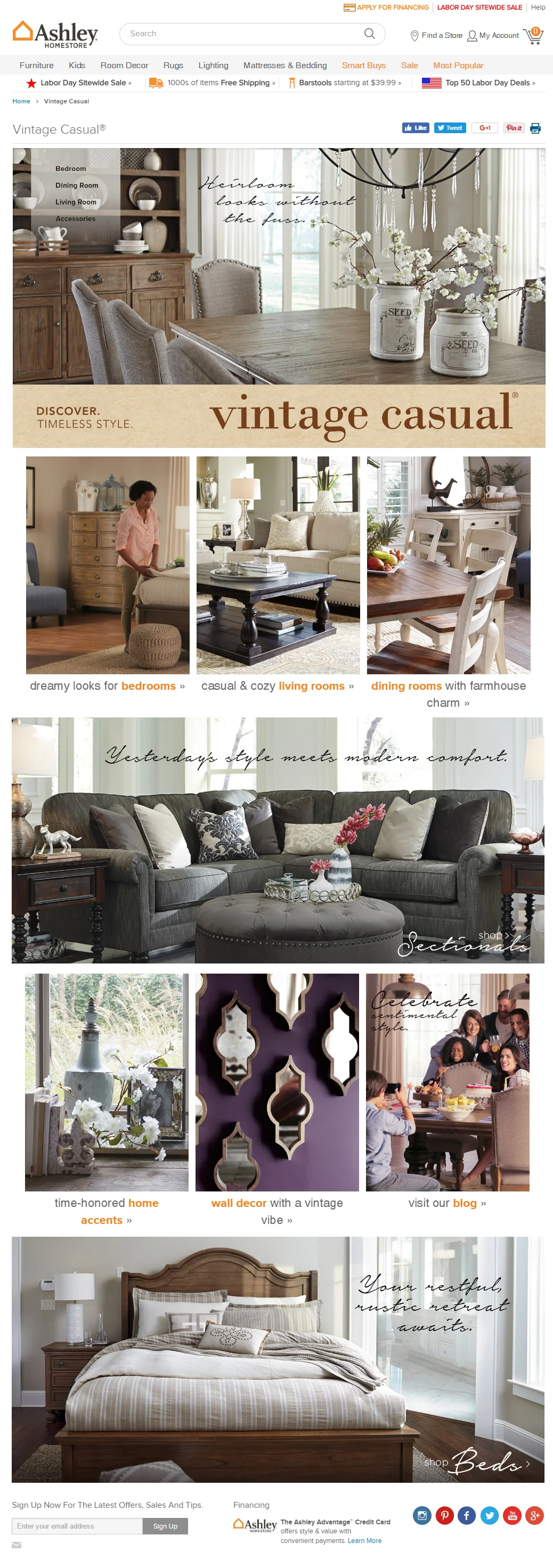
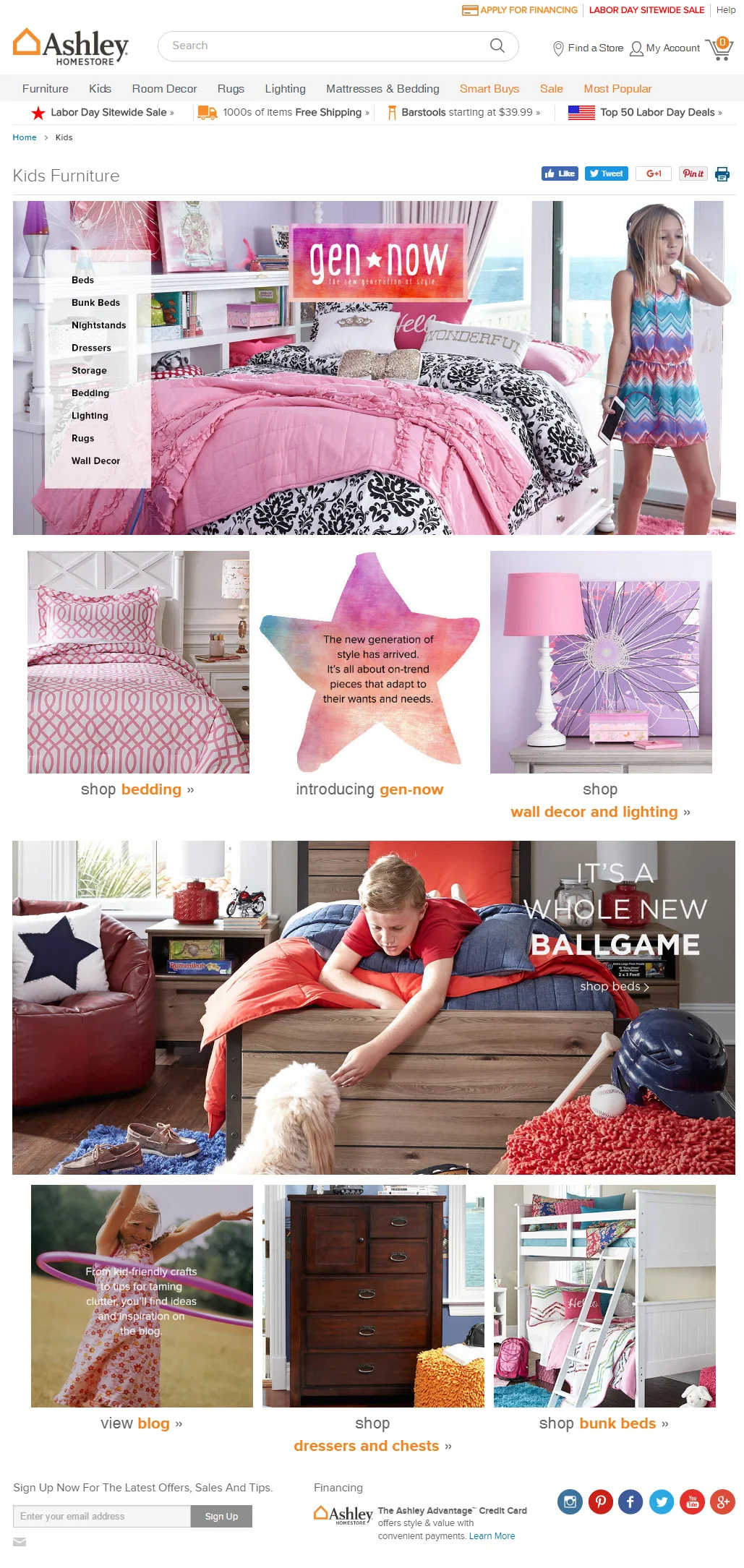
I spent years writing product copy for Ashley HomeStore. One of the most interesting creative challenges was this: the brand sold furniture across multiple distinct lifestyle segments. Each one had its own customer, its own aesthetic and its own personality. Every segment needed its own voice. But they all had to feel like they came from the same family.

Take a look at these four lifestyle segments. Same brand. Same furniture. Four completely different conversations.

Gen Now lifestyle landing page View full page
Gen Now
"The new generation of style has arrived."
Bold and a little loud. Written for teenagers who want to feel seen, not sold to. It earns attention by speaking directly into their worldview, not down at it.
Contemporary Living lifestyle landing page View full page
Contemporary Living
"Where stylish memories are made."
Polished and aspirational but never intimidating. It flatters the reader without overselling. The person on the other end wants to feel sophisticated. The copy lets them.
Vintage Casual lifestyle landing page View full page
Vintage Casual
"Heirloom looks without the fuss."
Warm, nostalgic and unhurried. It feels like a Sunday morning. No urgency, because this customer doesn't respond to urgency. They respond to comfort and familiarity.
Urbanology lifestyle landing page View full page
Urbanology
"City-chic looks for adventurous tastes."
Edgy, confident and a little restless. It assumes the reader already has a point of view. Because they do.

Four voices. All siblings. None of them strangers to each other — you can tell they came from the same family. But each one is having a completely different conversation, because each one is talking to a completely different person.

That's brand voice development done right. Not "pick some adjectives." Not "be more fun." Know who you're talking to. Then sound like it.

How to find your brand voice

Start by listening, not writing. The raw material for a real brand voice is almost always already there. In how your best customers describe you. In the emails your team sends when they're not being "professional." In the founder's offhand comments that make everyone laugh in meetings.

Ask the right questions. What do we sound like at our best? What do we sound like when no one's watching? What words would we never use? The "never" list is often more useful than the "always" list.

Then write. A lot. Read it out loud. If it sounds like something a human being would actually say, you're getting somewhere. If it sounds like a brand guidelines document, start over.

And this is the part most brands skip: build the guardrails. A voice that only lives in one copywriter's muscle memory disappears the moment someone new joins the team. Document it. Give it examples. Show what it sounds like when it's working and what it sounds like when it's not.

Brand voice development isn't a deliverable. It's a practice. The brands that get it right are the ones that treat it that way.

If your brand is still working off an adjective list, I can help you go deeper. Let's talk about what your brand voice could actually sound like.

Free download
Got a project? Start here.

Three questions. That's all it takes to brief a copywriter well. Download the template and find out what you actually need to say before you say it.

Download the brief