Tampa Bay's Financial Services Scene Is Booming. Is Your Brand's Copy Keeping Up?

Tampa Bay has a financial services problem. Not the industry itself — that's doing fine. Better than fine, actually. The problem is the copy.

Drive down the Selmon Expressway and count the bank billboards. Visit the websites of the credit unions, the fintechs, the wealth management firms setting up shop between St. Pete and Wesley Chapel. Read what they're saying. Most of it sounds exactly the same. Approachable. Trustworthy. Here for you.

Nobody believes it. And nobody remembers it.

The market is outgrowing the messaging

Tampa Bay has quietly become one of the fastest-growing financial services hubs in the southeast. Raymond James is here. Amscot is here. MIDFLORIDA Credit Union has been here for decades. The fintech corridor keeps expanding. And that's before you count the wave of financial services companies relocating from higher-cost markets.

More competition means more noise. And more noise means that "approachable and trustworthy" is not a differentiator anymore. It's a baseline. The brands that win in this market are the ones that figure out how to say something specific, in a voice that sounds like an actual human being, to a reader who has every reason to scroll past them.

That's a copywriting problem. And it's fixable.

What I've seen working in this market

I spent years writing financial services copy in Tampa Bay, most of it for MIDFLORIDA Credit Union. One of the most instructive projects was a social media and content campaign built around growing teen checking accounts. Simple goal. Hard audience.

Teenagers don't respond to features. They don't care about your routing number or your mobile app's star rating. What they care about is independence. Having their own money. Their own card. Their own financial life, separate from mom and dad.

So that's what we wrote about. Not the product. The feeling the product unlocks.

22%
teen checking account growth in six months
$1.2M
in new deposits by end of year

Not because the copy was clever. Because it was relevant to the right person at the right moment. That's the whole game.

Why financial services copy goes wrong

The problems are almost always the same three things.

Compliance paralysis kills the voice. Legal review is non-negotiable. But there's a difference between copy that protects the brand and copy that's been edited into oblivion. The fix isn't to fight compliance. It's to build a voice framework first, so the guardrails are already baked in before anyone picks up a red pen.

Corporate by default. Florida is not a formal state. Tampa Bay especially. The people your brand is trying to reach are checking your Instagram between innings at a Rays game, or scrolling while they wait for their Bern's reservation. Write to the actual human, not the hypothetical shareholder.

No real audience definition. "Adults 25 to 54" is not a person. "A 38-year-old in New Tampa trying to figure out whether to refinance before rates move again" is a person. Write for her. The 38-year-old in Lutz with a different problem gets her own message.

What this market actually rewards

Specificity. Local fluency. A voice that doesn't sound like it was generated by committee.

Tampa Bay readers know when they're being talked at. They've been to a Buccaneers game and seen the generic bank signage. They've opened the email from their credit union that started with "We're excited to share some important updates." They deleted it.

The brands that earn loyalty here are the ones that demonstrate they understand this market. Not just that they're in it. There's a difference. And readers feel it.

The fix

It's simpler than most brands want to believe.

Define one real person. Not a demographic. A person. Where do they live? What are they worried about? What would make them stop scrolling? Start there, every time.

Build the voice before the campaign. A strong brand voice framework means compliance has guardrails to work with, not a blank page to bleed on. Do the voice work first. Everything downstream gets easier.

Write for this market, not the generic one. Tampa Bay is specific. Use it. Name the neighborhoods, the situations, the financial realities that people here actually live with. Generic copy gets generic results.

If your financial services brand is ready to sound less like a disclosure and more like a conversation, let's talk. I've spent 20 years making complex topics feel human. I know this market. And I know what good copy can do in it.

Free download
Got a project? Start here.

Three questions. That's all it takes to brief a copywriter well. Download the template and find out what you actually need to say before you say it.

Download the brief

Internal Communications and Marketing Are the Same Job

Most organizations treat internal communications and marketing like two completely different disciplines. Different teams, different budgets, different skill sets. One talks to customers. One talks to employees. Never the twain shall meet.

That's a mistake. And it's costing you.

The truth is that internal communications and marketing flex exactly the same muscle. The craft is the same. The strategy is the same. The best practitioners can do both. And the organizations that figure that out get better work from both functions.

The audience changes. The job doesn't.

At its core, marketing is about getting the right message to the right person at the right moment, in a way that makes them think, feel or do something specific. That's it. Strip away the channels, the budgets, the campaign briefs. That's the whole job.

Now read that back and tell me it doesn't describe internal communications perfectly.

Your employees are an audience. They have competing priorities, limited attention spans and a very low tolerance for content that doesn't feel relevant to them. Sound familiar? It should. That's every marketing brief you've ever written.

The mistake leaders make is assuming that because the audience is internal, the standards can be lower. That a town hall invitation doesn't need a compelling subject line. That a SharePoint page doesn't need a clear hierarchy. That an all-hands recap doesn't need an editor.

It does. They all do.

A marketing brain changes how you write internal communications

Here's a concrete example. Writing an invitation to a town hall or employee engagement event sounds simple. It's not. Most internal comms writers treat it like an announcement. They state the date, the time, the topic and move on.

A marketing brain treats it like a conversion problem. What's going to make someone actually show up? What's the hook? What do they get out of it that they can't get from reading the recap later? A well-written town hall invitation with a strong CTA gets people in the room. A weak one gets a half-empty auditorium and a leader wondering why no one showed up.

That's not an engagement problem. That's a copywriting problem.

And an internal comms brain makes your marketing stronger

The other side is just as true. Internal comms practitioners are experts at writing for audiences who didn't ask to hear from you, on topics they may not care about, in an environment full of distractions. That's a hard brief. And it builds a specific kind of discipline that makes everything else sharper.

The campaign thinking that good internal comms requires is indistinguishable from marketing campaign thinking. When I'm running an internal communications campaign — say, a multi-touch rollout of a new policy or a culture initiative — I'm thinking in exactly the same terms as a product marketer. What does the audience already believe? What do I need them to believe instead? How do I weave a consistent thread through every email, every SharePoint page, every manager talking point so it all feels like one coherent story rather than a series of disconnected blasts?

That's brand thinking. That's campaign thinking. It just happens to live inside the firewall.

What this means if you're hiring

If you're building a communications function and treating internal comms and marketing as completely separate skill sets, you're limiting yourself unnecessarily. The best communications professionals move fluidly between both. They know how to write a subject line that gets opened and a leadership message that doesn't make people's eyes glaze over at paragraph two.

Look for the muscle, not the job title. Someone who has written externally facing campaigns and internal communications has seen both sides of the same coin. That perspective is rare and genuinely useful.

The org chart can stay. But the silos? Those can go.

If you're looking for a creative strategist who has spent 20+ years doing exactly this, let's talk.

Free download
Got a project? Start here.

Three questions. That's all it takes to brief a copywriter well. Download the template and find out what you actually need to say before you say it.

Download the brief

What Is Brand Voice — And Why Most Brands Get It Wrong

Every brand says they have a voice. Very few of them actually do.

What most brands have is a list of adjectives. "We're approachable. Confident. Human." Great. So is every other brand that's ever filled out a positioning workshop template. Adjectives are not a voice. They're a starting point at best. A false sense of security at worst.

Real brand voice is the thing that makes a reader recognize your brand before they see your logo. Consistent enough to be predictable. Distinctive enough to be unmistakable. And a lot harder to build than most brands think.

Voice vs. tone: they're not the same thing

This is where most brands get tangled up. Voice and tone are related, but they're not interchangeable.

Voice is who you are. It stays consistent regardless of context. Tone is how you show up in a given moment. It shifts depending on what you're saying and who you're saying it to. A brand can be warm and direct while still adjusting its tone for a product launch versus a service outage. Same person, different register.

Think of it this way: your voice is your personality. Your tone is your mood. Personality doesn't change. Mood does.

The mistake brands make is treating tone as voice. Rewriting their entire communication style for every channel or campaign, with no consistent thread running through any of it. The result is a brand that sounds like a different company every time you encounter it.

The performing personality problem

There's a specific failure mode I see constantly. And it usually comes from good intentions.

A brand decides it wants to be more relatable. So it adopts a quirky, casual, overly familiar voice. Not because that voice reflects anything true about the brand. Because someone in a strategy meeting decided that's what engagement looks like. The copy starts to feel try-hard. The whole thing reads like it's working too hard to be liked.

Readers feel it immediately. You can't perform a personality you don't have. Authenticity isn't a style choice. It's the byproduct of a voice that was actually discovered, not manufactured.

The best brand voices don't feel written. They feel like someone just opened their mouth and talked.

That takes work. But it's a specific kind of work. Less about creativity, more about excavation. You're not inventing a voice. You're finding the one that was already there.

What good brand voice development actually looks like

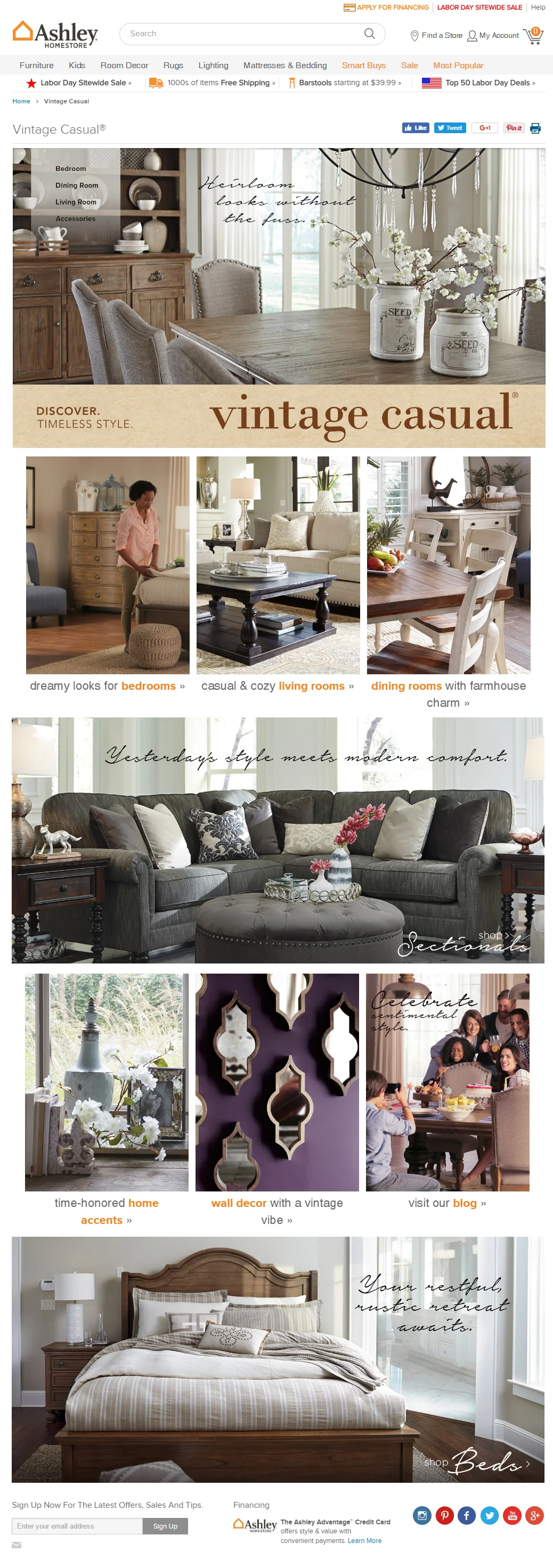
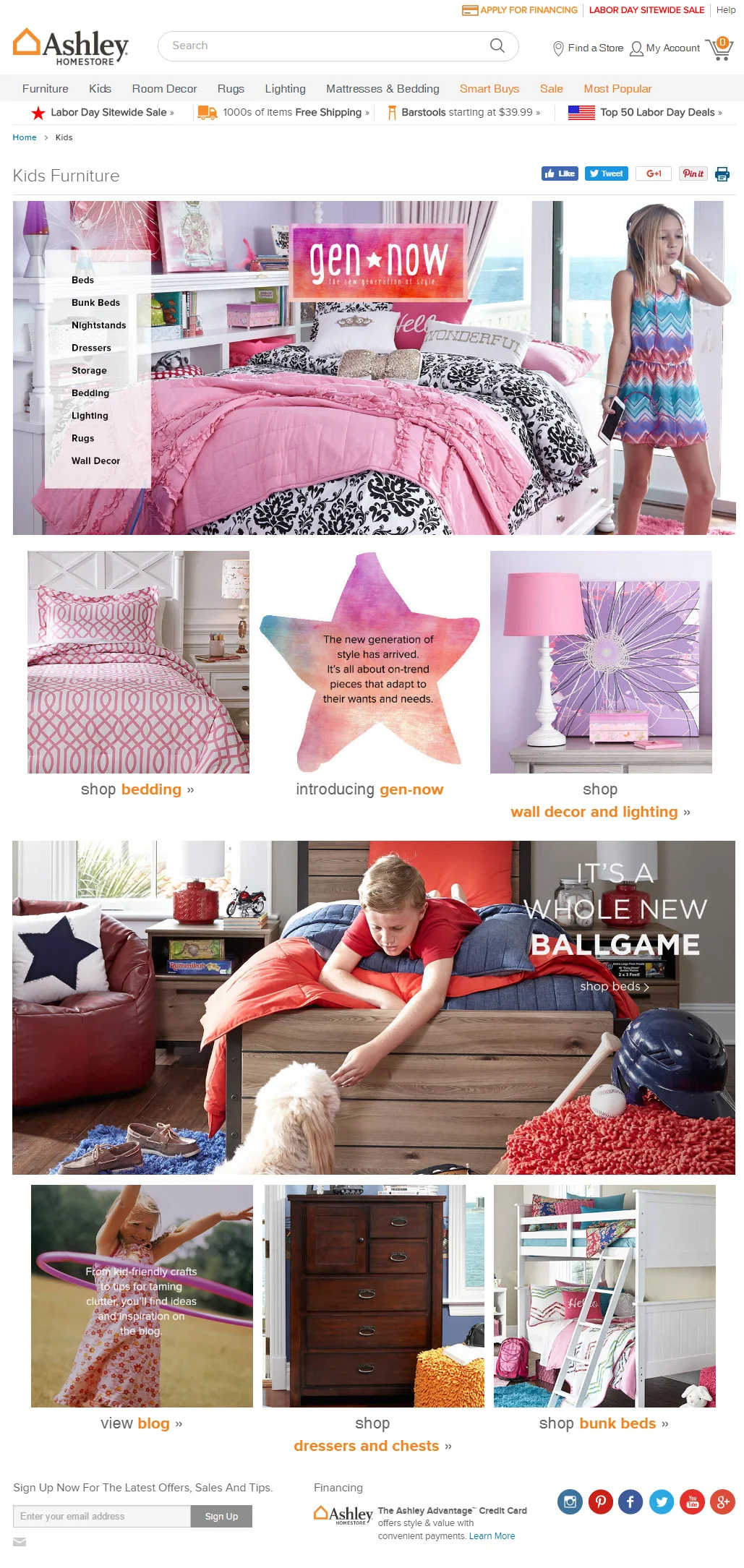
I spent years writing product copy for Ashley HomeStore. One of the most interesting creative challenges was this: the brand sold furniture across multiple distinct lifestyle segments. Each one had its own customer, its own aesthetic and its own personality. Every segment needed its own voice. But they all had to feel like they came from the same family.

Take a look at these four lifestyle segments. Same brand. Same furniture. Four completely different conversations.

Gen Now lifestyle landing page View full page
Gen Now
"The new generation of style has arrived."
Bold and a little loud. Written for teenagers who want to feel seen, not sold to. It earns attention by speaking directly into their worldview, not down at it.
Contemporary Living lifestyle landing page View full page
Contemporary Living
"Where stylish memories are made."
Polished and aspirational but never intimidating. It flatters the reader without overselling. The person on the other end wants to feel sophisticated. The copy lets them.
Vintage Casual lifestyle landing page View full page
Vintage Casual
"Heirloom looks without the fuss."
Warm, nostalgic and unhurried. It feels like a Sunday morning. No urgency, because this customer doesn't respond to urgency. They respond to comfort and familiarity.
Urbanology lifestyle landing page View full page
Urbanology
"City-chic looks for adventurous tastes."
Edgy, confident and a little restless. It assumes the reader already has a point of view. Because they do.

Four voices. All siblings. None of them strangers to each other — you can tell they came from the same family. But each one is having a completely different conversation, because each one is talking to a completely different person.

That's brand voice development done right. Not "pick some adjectives." Not "be more fun." Know who you're talking to. Then sound like it.

How to find your brand voice

Start by listening, not writing. The raw material for a real brand voice is almost always already there. In how your best customers describe you. In the emails your team sends when they're not being "professional." In the founder's offhand comments that make everyone laugh in meetings.

Ask the right questions. What do we sound like at our best? What do we sound like when no one's watching? What words would we never use? The "never" list is often more useful than the "always" list.

Then write. A lot. Read it out loud. If it sounds like something a human being would actually say, you're getting somewhere. If it sounds like a brand guidelines document, start over.

And this is the part most brands skip: build the guardrails. A voice that only lives in one copywriter's muscle memory disappears the moment someone new joins the team. Document it. Give it examples. Show what it sounds like when it's working and what it sounds like when it's not.

Brand voice development isn't a deliverable. It's a practice. The brands that get it right are the ones that treat it that way.

If your brand is still working off an adjective list, I can help you go deeper. Let's talk about what your brand voice could actually sound like.

Free download
Got a project? Start here.

Three questions. That's all it takes to brief a copywriter well. Download the template and find out what you actually need to say before you say it.

Download the brief